
Year-end tax planning isn't complicated in theory. You have a set of allowances and reliefs available to you each tax year. Some of them reset on 6 April and can't be carried forward. If you don't use them before 5 April, they're gone. The planning, therefore, is about knowing what's available, checking what you've used, and making deliberate decisions with what's left — before the deadline arrives.
In practice, most people don't do this. They either don't know what to check, or they leave it too late and end up making rushed decisions in the final week of March. This piece is a working guide to the areas worth reviewing, roughly in order of the impact they tend to have.
Pension contributions
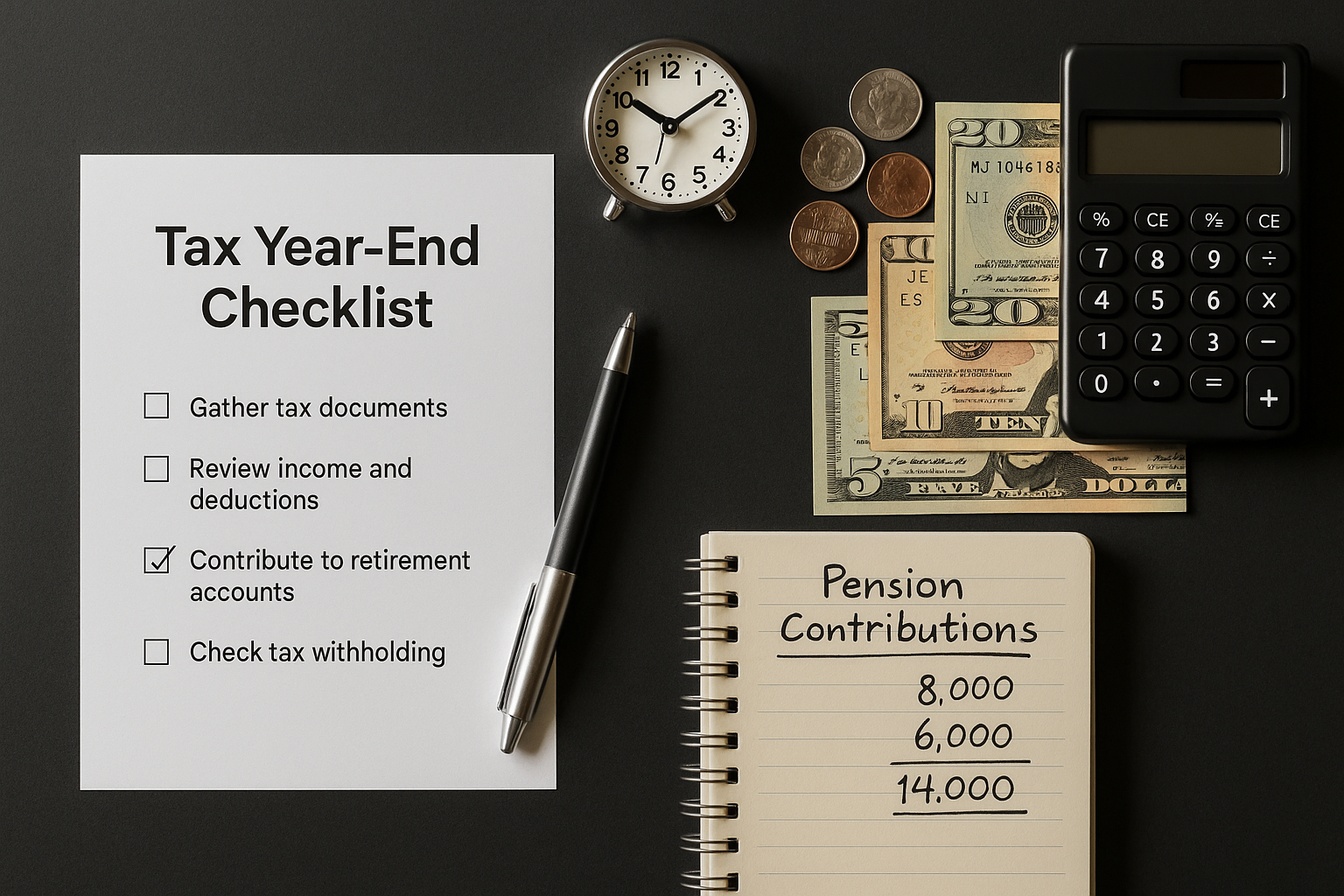
Pensions are the most powerful tax planning tool available to most individuals and business owners, and they're the one most commonly underused. You can contribute up to £60,000 per tax year into a registered pension scheme and receive full income tax relief on your contributions — meaning every £100 contributed costs a basic rate taxpayer £80, and a higher rate taxpayer £60.
There are a few things worth checking before 5 April:
- Have you used your full annual allowance for this year? If your earnings support it and you haven't contributed the maximum, the unused allowance disappears on 5 April.
- Do you have unused allowance from the previous three tax years? You can carry forward unused annual allowance from up to three years prior, but only once you've used the current year's allowance in full first.
- If you're a company director, is the company making pension contributions on your behalf? Employer contributions are a tax-deductible expense for the business and don't count as salary, making them particularly efficient.
The carry-forward rules mean there's sometimes a narrow window to make a large pension contribution that wipes out a significant tax liability. This is worth modelling properly before you act — the numbers can look very different depending on your specific situation.
ISA allowances
Every adult in the UK can put up to £20,000 into an ISA each tax year, sheltered from income tax and capital gains tax. This allowance does not carry forward. If you don't use it before 5 April, it's gone.
The same principle applies to Junior ISAs if you have children — £9,000 per child per year. These are less commonly used but equally worth reviewing.
ISA planning is less dramatic than pension planning in terms of immediate tax savings, but the long-term compounding of tax-free growth is significant. If you have cash sitting in savings accounts attracting interest that's being taxed, moving it into an ISA before the year end is a straightforward improvement.
Capital gains — use your annual exempt amount
Each individual has an annual capital gains tax exempt amount — for 2025/26, this is £3,000. Gains below this threshold in the tax year are free of CGT. Like the ISA allowance, this does not carry forward.
If you hold investments that are sitting on a gain, it's worth considering whether to realise some or all of that gain before 5 April to make use of the exempt amount. This is particularly relevant for people with general investment accounts (not ISAs or pensions) holding stocks, funds, or other assets.
Equally, if you have investments sitting on a loss, crystallising those losses before 5 April allows you to offset them against gains either now or in future years — losses can be carried forward indefinitely, unlike most allowances.
One caution: the "bed and breakfast" rules mean you can't simply sell and immediately repurchase the same asset to crystallise a gain or loss. You need to wait 30 days before buying back the same investment, or use a spouse or ISA wrapper to achieve a similar outcome.
Salary and dividend planning for directors
If you run your business through a limited company, the split between salary and dividends is one of the most impactful decisions you make each year — and it's worth reviewing before year end in case there's anything to adjust.
The optimal salary level for 2025/26 is typically £12,570 (the personal allowance) or £9,100 (just above the secondary NIC threshold, if the employment allowance isn't available). Taking more than this as salary tends to create a national insurance liability without a corresponding tax benefit for most directors.
Dividends above the £500 dividend allowance are taxed at 8.75% (basic rate), 33.75% (higher rate), and 39.35% (additional rate). If your income is approaching a threshold — particularly £50,270, where higher rate tax begins, or £100,000, where the personal allowance starts to taper — it's worth calculating whether it makes sense to bring dividend income forward into this tax year or defer it into the next, depending on your projected income in each year.
This is the kind of decision that looks simple in isolation but gets complicated quickly when you factor in company retained profits, other income, pension contributions, and the interaction between different thresholds. It's worth getting proper advice rather than guessing.
Gift Aid and charitable giving
If you're a higher or additional rate taxpayer and you make charitable donations, Gift Aid allows the charity to reclaim basic rate tax on your donation — but you can also claim the difference between the basic rate and your marginal rate through your Self Assessment return.
For a higher rate taxpayer donating £1,000 to charity under Gift Aid, the charity receives £1,250 (including the basic rate top-up), and you can claim a further £250 back through your tax return. The effective cost of a £1,000 donation is £750.
Donations made before 5 April can be included in this year's tax return. Donations made after 5 April fall into the next tax year.
Inheritance tax — annual gifting exemptions
If inheritance tax is part of your longer-term planning, the annual exemption allows you to gift up to £3,000 per tax year free of IHT. You can also carry forward one year's unused exemption, so if you didn't use it last year, you can gift up to £6,000 before 5 April without any IHT consequences.
Separately, the small gifts exemption allows you to give up to £250 per person per year to any number of individuals. These allowances aren't dramatic on their own, but used consistently over a number of years they can move meaningful amounts out of an estate.
Don't leave it to the last week
The most common mistake with year-end planning isn't choosing the wrong strategy — it's running out of time to implement the right one. Pension providers can be slow to process contributions. Investment accounts can take time to transfer. If you're making decisions in the final days of March, your options are already narrowed.
The businesses and individuals who consistently get the most out of year-end planning treat it as a February or early March exercise, not a late March one. That gives time to model scenarios properly, get advice on anything complex, and execute without rushing.
If you'd like to go through your own position before 5 April — whether it's pensions, dividends, capital gains, or any of the above — get in touch. We run year-end planning reviews for clients every year at this time, and the conversations are usually a lot more useful than people expect.